

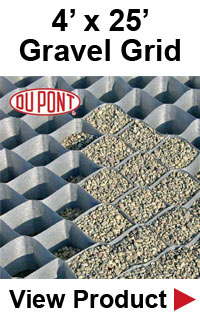


A Geocell (also called a ground grid or ground paver) is a honeycomb-shaped, three-dimensional cell structure made from virgin HDPE (high-density polyethylene) plastic.
When expanded and filled with gravel, sand, dirt, or grass, it creates a strong, stable, load-bearing surface that prevents erosion, rutting, and washboarding.
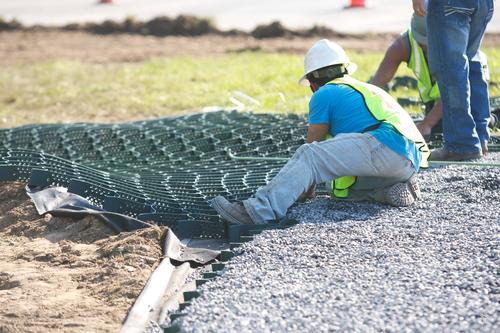
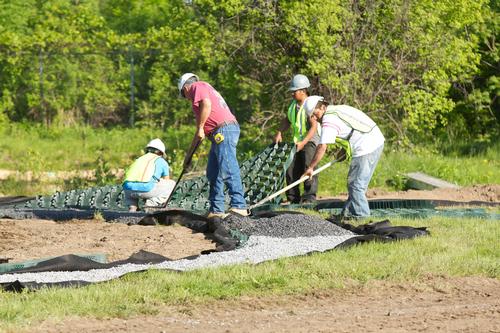
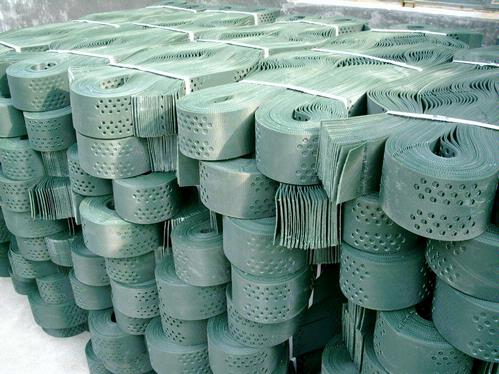
LSG grid — collapsed for shipping (left) and fully expanded on site (right)
You have four main infill options:
- Gravel — access roads, parking lots, boat ramps, RV parking, fire lanes
- Bonded Gravel (Gravel-Lok®) — walkways, patios, golf courses
- Grass / Turf — green driveways, overflow parking, vegetated ground cover, green roofs
- Dirt / Soil — erosion control and mud management
The system is flexible — you can mix applications across one project depending on use.
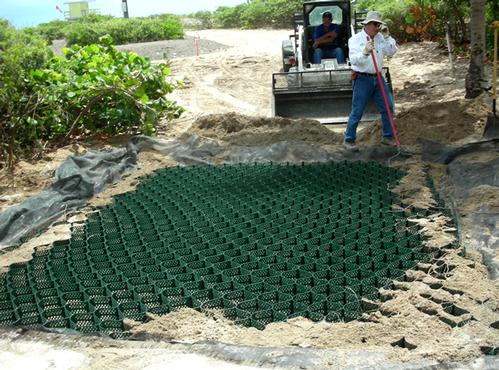
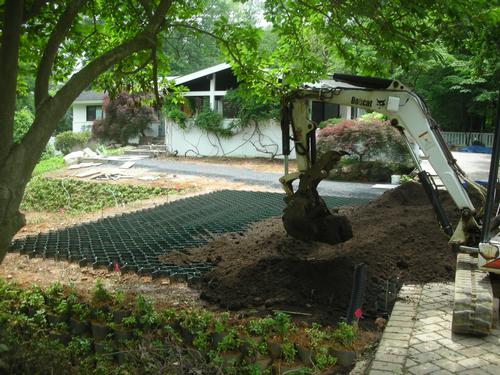
Gravel fill (left) and grass/turf fill (right)
The depth and compaction within the confined cells handles load distribution on its own. The LSG Series is equivalent to much thicker unconfined gravel layers:
- LSG-3 → equivalent to 12–14" of unconfined gravel
- LSG-4 → equivalent to 16–20" of unconfined gravel
- LSG-6 → equivalent to 24–30" of unconfined gravel
You also reduce required base thickness by up to 50% compared to traditional methods.
A non-woven geotextile fabric is required beneath the grid in most applications. This fabric:
- Prevents infill material from migrating into the ground
- Provides filtration and separation
- Allows water to drain freely through
We carry DuPont SF20 and SF40 non-woven geotextile fabric options to pair with your order.
The LSG system is fully permeable — water drains straight through rather than pooling on the surface. Water storage capacity by model:
Permeable surfaces also help recharge groundwater naturally and dramatically reduce runoff compared to concrete or asphalt.
- Reduces stormwater runoff
- Naturally recharges groundwater
- Captures airborne pollutants
- Safely distributes and filters car oil leakage
- Reduces hot surface temperatures vs. hardscape
- Made from recyclable HDPE plastic
- Residential driveways
- Overflow parking areas
- Access roads and fire access lanes
- Boat ramps
- Parking lots
- Golf cart paths
- Roadside shoulder reinforcement
- Ports and marinas
- RV parking
- Trails and pathways
- Paver base support (concrete and asphalt)
- Permeable paver support
- Green roofs and vegetated ground cover
- Mud management
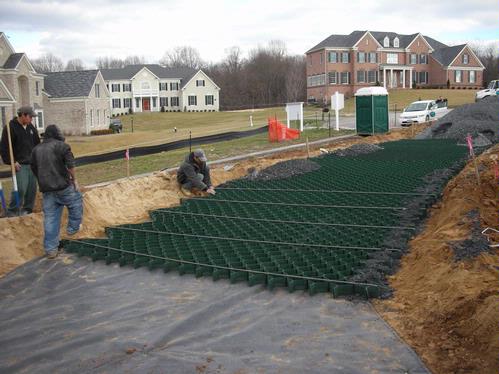
Access road (left) and parking area (right)
Each grid covers 180 square feet when fully expanded (8' × 22.5').
Example: 1,800 sq ft driveway ÷ 180 = 10 grids
All three models (LSG-3, LSG-4, LSG-6) use the same panel dimensions, so only the depth differs.
The LSG Series is manufactured from virgin HDPE (High-Density Polyethylene) — a durable, recyclable plastic engineered for long-term outdoor use.
- Density: 0.9574 g/cm³ (ASTM D1505)
- Sheet thickness: 1.45mm (ASTM D5199)
- Environmental stress cracking resistance: >6,000 hours (ASTM D1693); >400 hours (ASTM D5397)
- UV stabilized — hindered amine light stabilizer (HALS) at 1.0% by weight
- Fully expand each grid panel to 8' × 22.5'. Complete expansion is important for uniform cell shape.
- Cut to fit your project area as needed.
- Use spikes to temporarily hold the grid in place while working.
- Connect adjacent panels — Type 1: Cell Wall to Cell Wall | Type 2: Weld End to Weld End
- Secure seams with one staple per inch (pneumatic stapler for all depths; hand stapler for 3"–4" only; zip ties work for small jobs)
- Install 18" J-Hooks every 4 feet in all directions and along all perimeters
- One full grid (8' × 22.5') requires 18 J-Hooks
- Use 24" J-Hooks for LSG-6 (6" cells)
- Made from 1/2" (#4) rebar
- For permeable pavement: use clean, washed angular stone
- For grassy paving: use 50/50 topsoil + clean angular 3/4" stone
- Overfill by 1" above the top of the grid
- Avoid limestone — affects soil pH and inhibits grass growth
- 💡 Keep J-Hooks installed while filling — they hold the grid open so cells stay uniform
🧱 Option A — Brick Pavers
- Compacted subgrade
- DuPont SF20/SF40 fabric
- LSG grid + 3/4" angular stone fill
- DuPont SF20/SF40 fabric (protects setting bed)
- Concrete pavers with sand joints
⛏ Option B — Gravel Surface
- Compacted subgrade
- DuPont SF20/SF40 fabric
- LSG grid + 3/4" angular stone + J-Hooks
- 1"–2" granular surface layer
🌿 Option C — Grass / Turf
- Compacted subgrade
- Geogrid (deep root access)
- LSG grid + 50/50 aggregate/topsoil + J-Hooks
- 1" topsoil layer on top
🪨 Option D — Bonded Gravel (Gravel-Lok®)
- Compacted subgrade
- DuPont SF20/SF40 fabric
- LSG grid + 3/4" angular stone fill
- 1/2"–1" aggregate overfill layer
- Gravel-Lok® + decorative stone (3/8" angular recommended)
- Roller coat(s) of Gravel-Lok® liquid — allow 24 hrs between coats
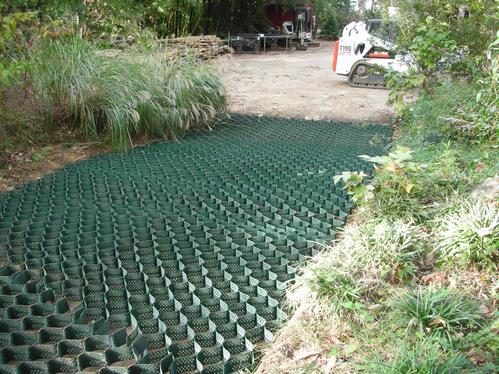

Installation in progress (left) and completed gravel surface (right)
| Use Case | Recommended Model |
|---|---|
| Residential driveway (cars / pickups) | LSG-3 LSG-4 |
| Grass reinforcement / overflow parking | LSG-3 LSG-4 |
| Light commercial / maintenance vehicles | LSG-4 |
| Gravel access road stabilization | LSG-4 LSG-6 |
| Fire lanes / heavy trucks / commercial | LSG-6 |